
AI ·
The Main Street AI Gap: Fix the Data Before the Model
Federal data show small firms trailing big ones on AI. The fix is rarely a better model. It is cleaner, connected records.
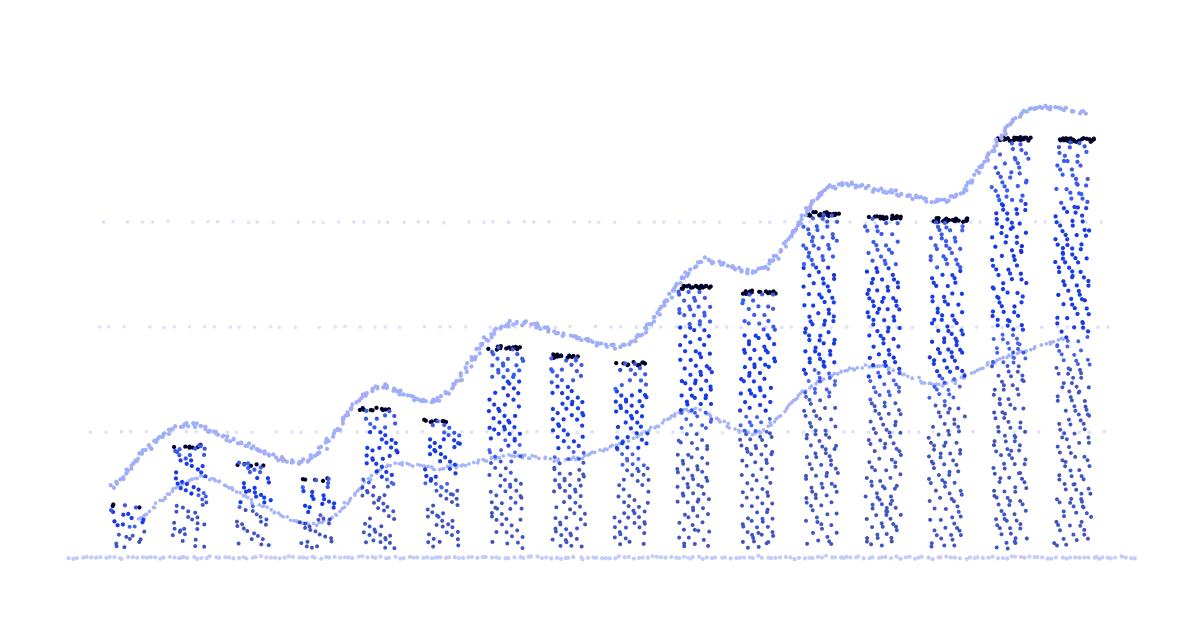
Among US companies with 250 or more employees, 37% told the Census Bureau this spring that they use AI in their operations. Among companies with four or fewer employees, the share was under 20%1. Over the same months, AI use rose at firms with at least 20 employees but did not change significantly at smaller ones1. The gap is not closing on its own.
Why are small firms falling behind? Our read: for most of them the problem is not access to a model. It is that their sales, stock, customers and books live in four different places, and no AI tool can see the whole business.
The gap, in official numbers
The Census Bureau's Business Trends and Outlook Survey asks firms about AI use on a recurring basis. As of 3 May 2026, 19.8% of businesses said they used AI in a business function, and the national rate held between 17% and 20% from December 2025 to May 20261. The survey changed its question in November 2025 from AI used in producing goods or services to AI used in any business function, so older figures are not directly comparable1.
Size matters a great deal. Firms with 100 to 249 employees reported 32% use, close to the 37% at the largest firms, while the smallest firms stayed below 20%1. Sector matters too: about 14% of retail businesses use AI, against 39.7% in the information sector1.
19.8%
of US businesses used AI in a business function, as of 3 May 20261
The Federal Reserve's Small Business Credit Survey paints a broader picture. In its 2026 report on employer firms (6,525 responses from businesses with 1 to 499 employees, a convenience sample fielded from September to November 2025), 46% said the business or its employees use AI, another 15% planned to start within a year, and one-third had no plans2. The surveys use different questions and samples, but they agree on the shape: plenty of trying, much less depth.
Using AI is not the same as running on it
The Fed survey asked AI users how far they had gone. About half were still experimenting. Another 44% had partially integrated AI into their processes. Just 7% had fully integrated it2.
7%
of small employers that use AI have fully integrated it into the business2
What they use it for tells the story. Writing or marketing leads at 83%, then individual productivity at 61% and planning or analysis at 51%2. The payoff is real but modest: 71% of users reported higher productivity and 31% reported higher sales, while most saw no change in labor costs2. Their top problems were accuracy (46%) and adapting tools to their business needs (43%)2. Among firms with no plans to adopt, more than half said AI is not applicable to their business2, and the Minneapolis Fed found that AI not applying to their operations was the most common reason non-adopters gave in Census data4.
Our read: a chat window can draft an email with no context. It cannot tell you what to reorder when sales sit in the point-of-sale system, stock counts in a spreadsheet, supplier lead times in someone's inbox and payments in the bank portal. When an owner says AI does not apply to the business, it often means the AI cannot see the business. It may also explain part of the accuracy complaint: a model working from partial or stale records can be confidently wrong.
What the jobs data say, and do not say
The Minneapolis Fed reports that roughly 96% of AI-using companies reported no change in employment, while 10% said AI now does tasks employees used to do4. The New York Fed found that small firms using AI expected to grow headcount more than non-users: a net +33 points against +15, with a gap of 10 to 13 points remaining after controls3.
AI use is associated with more optimistic expectations about future employment and revenue growth
The authors are careful to call this an association, not proof that AI causes growth3.
There is one pressure point. Using ADP payroll data, Stanford's Digital Economy Lab found that employment for workers aged 22 to 25 in highly AI-exposed occupations was about 19% below where it would otherwise be as of June 2026, mainly through reduced hiring of young workers rather than layoffs5. The authors describe these as descriptive patterns, not causal estimates5.
We do not see widespread, economy-wide job displacement associated with AI.
What we tell clients: the tasks AI absorbs first (data entry, matching payments, first drafts) are the same tasks a new hire used to learn the business on. Decide on purpose how your next junior employee will learn.
Four starting uses that pay back
What we tell clients: start with one decision you make every week, where a wrong answer is cheap to catch. Each of these needs specific data, and each needs a person to check the output, because accuracy is the top complaint among small-business users2.
- Reorder forecasts from sales history. Needs item-level sales by day, current on-hand counts and supplier lead times in one place. The output is a suggested order list that the buyer approves.
- Drafting customer messages. Back-in-stock notes, appointment reminders and replies to common questions. Needs a clean customer list with purchase history and a record of who agreed to be contacted. A person sends.
- Reconciling payments. Matching card-processor deposits and bank transactions to invoices, and flagging what does not match. Needs consistent invoice numbers and a regular bank feed. The bookkeeper resolves exceptions.
- A Monday summary of last week. Sales, margin, stock-outs and overdue invoices in plain language. Needs the books and the sales system to agree, which is itself a useful test.
46%
of small-business AI users named accuracy as a top challenge2
Fix the data first, and keep customers safe
None of the four uses work on scattered spreadsheets. What we tell clients: the fixes are unglamorous and mostly free.
- One item list. Every product has one code, one name and one unit of measure, used by the till, the stockroom and the books.
- One customer list. Merge duplicates, record contact consent, and stop keeping a second list in someone's phone.
- Every sale at item level. "Misc sale, $40" teaches a forecast nothing.
- Books reconciled on a schedule. Monthly at minimum, so the summary the AI writes matches the bank.
Customer data needs the same discipline. The Federal Trade Commission's guide for businesses rests on five principles: know what personal information you hold, keep only what you need, protect what you keep, dispose of what you no longer need, and plan for incidents6. Applied to AI, our advice is simple. Do not paste full customer records into free consumer chat tools. Read a vendor's data terms before connecting it to your systems, give it access only to the data the task needs, and name one person who approves new tools.
The pattern underneath all of this is a single connected system of record. That is the thinking behind Goúri, Olympas's ERP, point-of-sale and e-commerce platform for small and midsize businesses: one place where sales, stock, customers and books agree, so the data is ready when you choose an AI tool.
What to do now
- Pick one weekly decision (reorders, collections or the Monday numbers) and write down every place its data lives today.
- Consolidate to one item list and one customer list this quarter, and set a fixed monthly date to reconcile the books.
- Run one 30-day trial of a single use from the list above, with a named person signing off every output. Compare time spent and errors against the previous month.
- Write a one-page data rule covering what customer information may go into AI tools and who approves new ones, using the FTC's five principles as the outline6.
- Plan the junior role on purpose. List the tasks a new hire should still learn by hand before AI takes them over.
Sources
- 01Large Firms With at Least 20 Employees Biggest AI UsersUS Census Bureau (Adam Grundy, Cory Breaux, Dhanapati Khatiwoda) ·
- 022026 Report on Employer Firms: Findings from the Small Business Credit SurveyFederal Reserve Banks ·
- 03AI Adoption and Employment Expectations: Evidence from a Survey of Small Business OwnersFederal Reserve Bank of New York, Liberty Street Economics (Will Aarons, Asani Sarkar) ·
- 04AI adoption in business grows steadily but unevenlyFederal Reserve Bank of Minneapolis (Erick Garcia Luna) ·
- 05No Widespread Displacement, but the AI Employment Gap for Young Workers Has Widened to 19%Stanford Digital Economy Lab (Erik Brynjolfsson, Bharat Chandar, Ruyu Chen) ·
- 06Protecting Personal Information: A Guide for BusinessFederal Trade Commission ·
Start a project
The notes come from the work. The work starts with a conversation.
Tell us the problem in your own words. If it is close to something we have written about, say so.
A real engineer will read it and reply, usually within one business day.
Olympas LLC · 111 Calvin St, Savoy, IL · From global supply chains to the shop counter